Primarily used in medical and cosmetic fields, Thymosin Beta-4 promotes cell migration and reduces inflammation, enhancing wound healing and tissue regeneration.
Thymosin Beta-4 (TB-4) is a small peptide composed of 43 amino acids. It is a naturally occurring molecule found in many animal and human tissues, including the thymus gland, where it was first discovered. TB-4 has been shown to have a variety of biological functions, including wound healing, tissue repair, and anti-inflammatory effects.
TB-4 is believed to play a key role in regulating cell migration, differentiation, and proliferation. It has been found to promote the formation of blood vessels, improve tissue regeneration, and protect against tissue damage caused by various stressors.
Due to its potential therapeutic applications, TB-4 has been the subject of extensive research in recent years. It is currently being investigated for its potential use in the treatment of a variety of medical conditions, including cardiovascular disease, neurological disorders, and musculoskeletal injuries.
Benefits
Calms muscle spasm
Improves muscle tone
Helps maintain flexibility
Encourages tissue repair
Increases endurance and strength
Reduces inflammation of tissue in joints
Encourages growth of new blood cells in tissue
Increases exchange of substances between cells
Prevents the formation of adhesions and fibrous bands in muscles, tendons, and ligaments
Protocols
Content and Potency
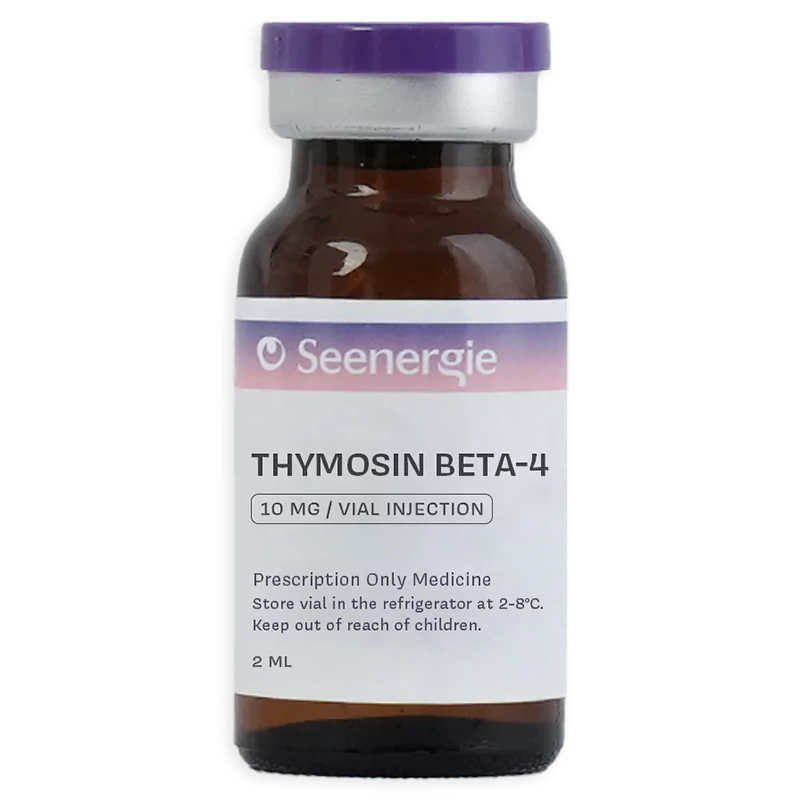
Provided as a 10mg lyophilized vial
Suggested Dosage
Initiation: Thymosin Beta 4 therapy is initiated to support tissue repair, reduce inflammation, and enhance recovery.
Initial Dose: Begin with 0.5 mg (0.1 ml or 10 units) subcutaneously once daily (SCOD) for the first two weeks to assess tolerance and minimize potential side effects.
Titration: If well tolerated, the dose may be increased to 1 mg (0.2 ml or 20 units) subcutaneously once daily (SCOD) after the initial two-week period.
Maintenance: Maintain the dose at 0.5-1 mg (0.1-0.2 ml or 10-20 units) subcutaneously once daily for ongoing support in tissue repair and overall recovery enhancement.
Duration: Thymosin Beta 4 is administered once daily.
Weeks 1-2: 0.5 mg (0.1 ml or 10 units) of Thymosin Beta 4 once daily
Week 3 and onwards: 0.5-1 mg (0.1-0.2 ml or 10-20 units) of Thymosin Beta 4 once daily
*Provided as a standard protocol, dose may vary depending on the condition of the patient. *The dosage of Thymosin Beta 4 may be adjusted based on the individual’s response, medical history, and specific treatment goals.
Restrictions
Known hypersensitivity to Thymosin Beta 4 or any component of the formulation.
Not recommended for use during pregnancy or breastfeeding unless specifically advised by a healthcare provider.
Requirements
Regular monitoring of tissue and recovery health to assess the effectiveness of the treatment.
Periodic blood tests to check for any adverse effects and to adjust the treatment as necessary.
Procedure
Thymosin Beta-4
Reconstitution
Draw 2 ml of sterile water for injection into a syringe.
Inject the sterile water into a vial containing 10 mg of Thymosin Beta 4 peptide.
Gently swirl the vial until the peptide is fully dissolved.
Administration
Remove the cap from a tuberculin syringe.
Draw the reconstituted Thymosin Beta 4 solution into the syringe to the required dosage (0.1 ml or 10 units initially, 0.2 ml or 20 units after titration).
Clean the selected injection site with an alcohol swab.
Pinch the sanitized skin and insert the needle at a 90-degree angle.
Administer the injection subcutaneously.
For next usage
Store the remaining Thymosin Beta 4 solution in the refrigerator at 2-8°C.
Before the next use, clean the vial top with an alcohol swab.
Use a new syringe for each administration.
Ensure to rotate injection sites (abdomen, thigh, or upper arm) to minimize skin irritation.
Clinical Research
Study:
Thymosin Beta-4 (Tβ4) for Hair Growth and Health
Source:
Frontiers, Translational Medicine Communications, Cochrane Handbook
Results:
Thymosin Beta-4 (Tβ4) has shown significant promise in promoting hair growth and improving overall hair health. This small peptide is naturally occurring in the body and is involved in various regenerative processes.
Tβ4 promotes hair growth by enhancing cell proliferation, migration, and survival within hair follicles. It plays a crucial role in activating stem cells in the hair follicles, which are essential for initiating and maintaining the hair growth cycle. Tβ4 also aids in angiogenesis (the formation of new blood vessels), ensuring that hair follicles receive adequate blood supply and nutrients, which are vital for healthy hair growth.
Frontiers, 2018; Translational Medicine Communications, 2020; Cochrane Handbook, 2023.
Thymosin beta-4 (Tβ4) is known to induce hair growth and hair follicle (HF) development; however, its mechanism of action is unknown. We generated mice that overexpressed Tβ4 in the epidermis, as well as Tβ4 global knockout mice, to study the role of Tβ4 in HF development and explore the mechanism of Tβ4 on hair growth.
Thymosin beta4 increases hair growth by activation of hair follicle stem cells
Thymosin beta4, a 43-amino acid polypeptide that is an important mediator of cell migration and differentiation, also promotes angiogenesis and wound healing. Here, we report that thymosin beta4 stimulates hair growth in normal rats and mice. A specific subset of hair follicular keratinocytes in mouse skin expresses thymosin beta4 in a highly coordinated manner during […]
Next to BPC-157, Thymosin Beta 4 (TB4, and sometimes mistakenly called TB500) is the most prescribed peptide in my office for patients who are in pain. These short cycles of TB4 can have a dramatic impact on the healing trajectory of many chronic pain conditions.
Have you heard of Thymosin Beta 4? Some people know it as TB4, or TB-500. In this video, I’m going to discuss this popular peptide, what it is, and its potential role in boosting the healing of orthopedic injuries, like ankle sprains, MCL and ACL injuries of the knee.