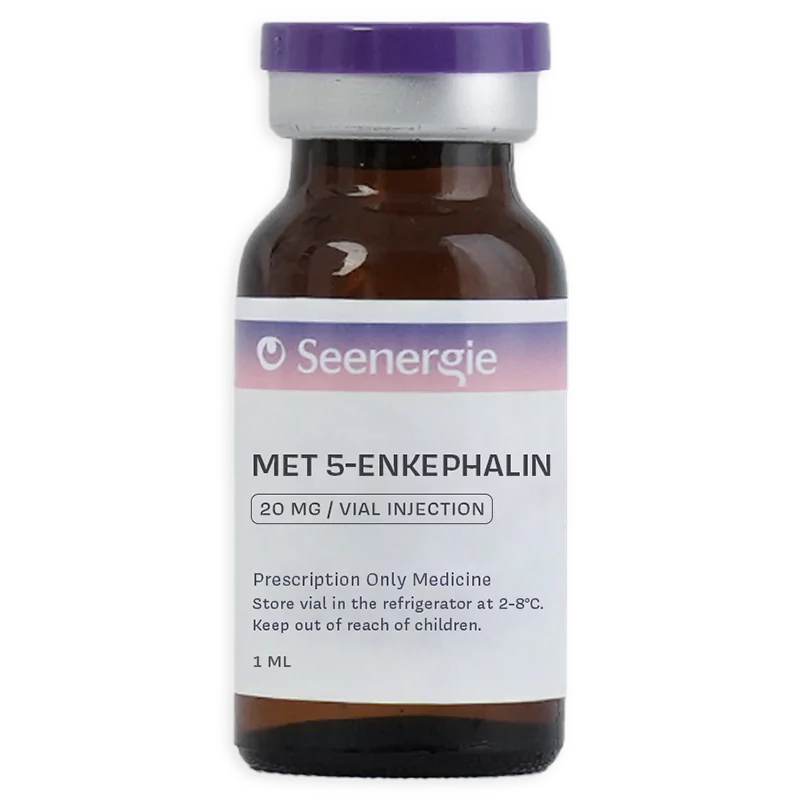
Met 5-Enkephalin

Activates opioid receptors to relieve pain, regulate the mood, and enhance immune functions.

Active ingredient:

5 amino acids

Molecular formula:

C28H35N5O7S

Molecular weight:

613.68 g/mol

Intake:

Injection

Met 5-Enkephalin

Active ingredient:

5 amino acids

Molecular formula:

C28H35N5O7S

Molecular weight:

613.68 g/mol

Intake:

Injection

What is

Met 5-Enkephalin

Met-Enkephalin, also known as the opioid growth factor (OGF), is an important component of the OGF-OGF receptor (OGFr) axis, functioning in both animal and human cancer cell lines and tumors. Met 5-Enkephalin is a synthetic variant of the naturally occurring endogenous opioid peptide metenkephalin. It acts as an agonist for zeta- and delta-opioid receptors, and to a lesser extent, the mu-opioid receptor

Benefits

  • Provides pain relief
  • Helps alleviate depression
  • Regulates memory responses
  • Modulates the immune system
  • Enhances gastrointestinal (GI) movement
  • Facilitates tissue growth and regeneration

Protocols

Provided as a 20mg lyophilized vial

  • Initiation: Met 5-Enkephalin therapy is initiated to modulate immune response and provide analgesic effects.
  • Initial Dose: Begin with 5 mg (0.25 ml or 25 units) subcutaneously twice daily (BID) twice weekly (2 days per week) for the first two weeks to assess tolerance and minimize potential side effects.
  • Titration: If well tolerated, increase the dose to 10 mg (0.5 ml or 50 units) subcutaneously twice daily (BID) twice weekly (2 days per week) after the initial two-week period.
  • Maintenance: Maintain the dose at 10 mg (0.5 ml or 50 units) subcutaneously twice daily (BID) twice weekly for ongoing support in immune modulation and analgesia.
  • Duration: Met 5-Enkephalin is administered twice daily on two days per week.
  • Weeks 1-2: 5 mg (0.25 ml or 25 units) of Met 5-Enkephalin twice daily on two days per week
  • Week 3 and onwards: 10 mg (0.5 ml or 50 units) of Met 5-Enkephalin twice daily on two days per week

*Provided as a standard protocol, dose may vary depending on the condition of the patient.
*The dosage of Met 5-Enkephalin may be adjusted based on the individual’s response, medical history, and specific treatment goals.

  • Known hypersensitivity to Met 5-Enkephalin or any component of the formulation.
  • Not recommended for use during pregnancy or breastfeeding unless specifically advised by a healthcare provider.
  • Caution in patients with a history of substance abuse, as Met 5-Enkephalin is an opioid peptide.
  • Avoid use in patients with severe hepatic or renal impairment without close medical supervision.
  • Patients with chronic pain conditions should be closely monitored to prevent potential dependence or misuse.

  • Regular monitoring of immune function and pain levels to assess the effectiveness of the treatment.
  • Periodic blood tests to check for any adverse effects and to adjust the treatment as necessary.
  • Consultation with a healthcare professional before starting Met 5-Enkephalin to ensure it is appropriate for the patient’s health condition.
  • Patients should be informed about the potential for opioid-like side effects and the importance of adherence to the prescribed dosage

Procedure

Reconstitution

  • Draw 1 ml of sterile water for injection into a syringe.
  • Inject the sterile water into a vial containing 20 mg of Met 5-Enkephalin peptide.
  • Gently swirl the vial until the peptide is fully dissolved.

  • Remove the cap from a tuberculin syringe.
  • Draw the reconstituted Met 5-Enkephalin solution into the syringe to the required dosage (0.25 ml or 25 units initially, 0.5 ml or 50 units after titration).
  • Clean the selected injection site with an alcohol swab.
  • Pinch the sanitized skin and insert the needle at a 90-degree angle.
  • Administer the injection subcutaneously.

  • Store the remaining Met 5-Enkephalin solution in the refrigerator at 2-8°C.
  • Before the next use, clean the vial top with an alcohol swab.
  • Use a new syringe for each administration.
  • Ensure to rotate injection sites (abdomen, thigh, or upper arm) to minimize skin irritation.

Clinical Research

Study:

Met 5-Enkephalin (MENK) for Pain Modulation and Cancer Therapy

Source:

PeptideWiki, International Peptide Society, Oxford Academic

Results:

Met 5-Enkephalin (MENK), also known as opioid growth factor (OGF), is an endogenous opioid peptide that has shown significant potential in pain modulation and cancer therapyMENK plays a crucial role in modulating pain perception. Clinical trials have investigated its analgesic effects in various settings:

MENK plays a crucial role in modulating pain perception. Clinical trials have investigated its analgesic effects in various settings:Acute Postoperative Pain: A clinical trial involving patients undergoing major abdominal surgery found that MENK significantly reduced postoperative pain intensity compared to placebo. This suggests that MENK may be a promising option for managing acute postoperative pain​ (PTides)​. Chronic Pain Management: Another trial assessed MENK’s efficacy in managing chronic pain conditions, including neuropathic and musculoskeletal pain. The results indicated significant reductions in pain levels among participants receiving MENK, highlighting its potential as a chronic pain treatment​

Cancer Therapy: MENK has also been studied for its therapeutic potential in cancer treatment: Pancreatic Cancer: A phase II clinical trial involving patients with advanced pancreatic cancer who had failed standard chemotherapy showed that MENK treatment led to a three-fold increase in median survival time compared to untreated patients. Additionally, tumor size was stabilized or reduced in 62% of the patients, and no adverse effects on blood chemistry were observed, indicating the safety and potential efficacy of MENK in cancer therapy.

PeptideWiki, 2023; International Peptide Society, 2023; Oxford Academic, 1980.

Read More: https://www.peptideswiki.org/, https://www.peptidesociety.org/, https://academic.oup.com/

Articles

Effects of an Oral Ghrelin Mimetic on Body Composition and Clinical Outcomes in Healthy Older Adults: A Randomized, Controlled Trial

Daily MK-677 significantly increased GH and IGF-I levels to those of healthy young adults without serious adverse effects. With placebo, mean (95% Cl) FFM decreased -0.5 (-1.1 to 0.2) kg, however, FFM increased 1.1 (0.7 to 1.5) kg with MK-677 (P<0.001, MK-677 vs. placebo); body cell mass as reflected by intracellular water decreased -1.0 (-2.1 […]

Hepatoprotective Effects of Met-enkephalin on Acetaminophen-Induced Liver Lesions in Male CBA Mice

Recent histopathological investigations in patients with hepatitis suggested possible involvement of Met-enkephalin and its receptors in the pathophysiology of hepatitis. Consequently, we evaluated the potential hepatoprotective effects of this endogenous opioid pentapeptide in the experimental model of acetaminophen induced hepatotoxicity in male CBA mice.

Conformation of Met5-enkephalin determined by high field PMR spectroscopy

THE discovery by Hughes et al.1 that peptides (the enkephalins) could be the endogenous agonists of opiates in brain represents a challenge to medical chemistry both in its fundamental aspects and for the possible development of new therapeutic approaches. To understand how non-peptidic substances belonging to various chemical classes can mimic the action of the […]