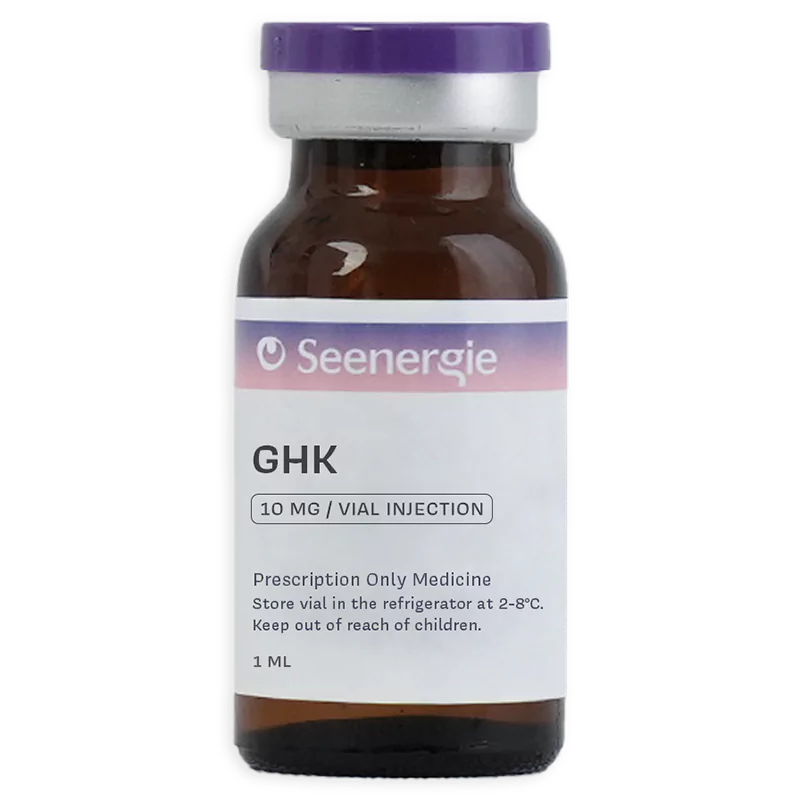
GHK

Known for its regenerative and healing properties, particularly in skin and hair care, because of its benefits in collagen production, wound healing, and inflammation reduction.

Active ingredient:

Glycyl-L-histidyl-L-lysine tripeptide

Molecular formula:

C14H24N6O4

Molecular weight:

340.4 g/mol

Intake:

Injection

GHK

Active ingredient:

Glycyl-L-histidyl-L-lysine tripeptide

Molecular formula:

C14H24N6O4

Molecular weight:

340.4 g/mol

Intake:

Injection

What is

GHK

GHK, or glycyl-histidyl-lysine, is a tripeptide naturally present in human plasma, saliva, and urine. In plasma, GHK levels are approximately 200 ng/mL at the age of 20 but decline to 80 ng/mL by the age of 60. This reduction in GHK levels corresponds with the noticeable decrease in an organism’s regenerative capacity. Scientific research has unveiled that GHK plays a role in wound healing, infection control, hair growth, cancer, cognitive health, and facial cosmetic applications.

Benefits

  • Activates DNA repair genes
  • Acts as an antioxidant defense
  • Suppresses fibrinogen synthesis
  • Suppresses insulin and insulin-like genes
  • Activates the Ubiquitin/Proteasome System (UPS)
  • Facilitates tissue repair through the TGF Superfamily

Protocols

Provided as a 10mg lyophilized vial

  • Initiation: GHK therapy is initiated to support tissue repair, reduce inflammation, and enhance skin health.
  • Initial Dose: Begin with 1.25 mg (0.125 ml or 12.5 units) subcutaneously three times per week to assess tolerance and minimize potential side effects.
  • Titration: If well tolerated, increase the dose to 2.5 mg (0.25 ml or 25 units) subcutaneously three times per week after the initial two-week period.
  • Maintenance: Maintain the dose at 2.5 mg (0.25 ml or 25 units) subcutaneously three times per week for ongoing support in tissue repair and overall skin health.
  • Duration: Maintain the dose at 2.5 mg (0.25 ml or 25 units) subcutaneously three times per week for ongoing support in tissue repair and overall skin health.
  • Weeks 1-2: 1.25 mg (0.125 ml or 12.5 units) of GHK three times per week
  • Week 3 and onwards: 2.5 mg (0.25 ml or 25 units) of GHK three times per week

*Provided as a standard protocol, dose may vary depending on the condition of the patient.
*The dosage of GHK may be adjusted based on the individual’s response, medical history, and specific treatment goals.

  • Known hypersensitivity to GHK or any component of the formulation.
  • Not recommended for use during pregnancy or breastfeeding unless specifically advised by a healthcare provider.

  • Regular monitoring of skin and tissue health to assess the effectiveness of the treatment.
  • Periodic blood tests to check for any adverse effects and to adjust the treatment as necessary.

Procedure

Reconstitution

  • Draw 1 ml of sterile water for injection into a syringe.
  • Inject the sterile water into a vial containing 10 mg of GHK peptide.
  • Gently swirl the vial until the peptide is fully dissolved.

  • Remove the cap from a tuberculin syringe.
  • Draw the reconstituted GHK solution into the syringe to the required dosage (0.125 ml or 12.5 units initially, 0.25 ml or 25 units after titration).
  • Clean the selected injection site with an alcohol swab.
  • Pinch the sanitized skin and insert the needle at a 90-degree angle.
  • Administer the injection subcutaneously.

  • Store the remaining GHK solution in the refrigerator at 2-8°C.
  • Before the next use, clean the vial top with an alcohol swab.
  • Use a new syringe for each administration.
  • Ensure to rotate injection sites (abdomen, thigh, or upper arm) to minimize skin irritation. )

Clinical Research

Study:

GHK Peptide for Hair Health

Source:

MDPI, Cochrane Handbook, Peptides Institute

Results:

GHK, a tripeptide composed of glycine, histidine, and lysine, has demonstrated significant benefits for hair health and growth. The peptide naturally occurs in human plasma and can be released from tissues during injury. Research has shown that GHK enhances hair growth and improves overall hair health through various mechanisms.

Studies have demonstrated that GHK can significantly enhance hair growth. By improving the health of hair follicles and supporting the production of hair growth factors, GHK facilitates the regeneration of hair, even in areas affected by thinning or loss.The peptide’s ability to block DHT helps reduce hair loss, particularly in androgenetic alopecia (pattern baldness). This mechanism is crucial for maintaining existing hair and promoting the growth of new hair strands.GHK promotes the enlargement of hair follicles, resulting in increased hair thickness and density. Users have reported noticeable improvements in the overall volume and strength of their hair​.

MDPI, 2018; Cochrane Handbook, 2023; Peptides Institute, 2023.

Read More: https://doi.org/10.3390/ijms19071987, https://www.cochrane-handbook.org/, https://www.peptidesinstitute.org/

Articles

GHK Peptide as a Natural Modulator of Multiple Cellular Pathways in Skin Regeneration

GHK (glycyl-L-histidyl-L-lysine) is present in human plasma, saliva, and urine but declines with age. It is proposed that GHK functions as a complex with copper 2+ which accelerates wound healing and skin repair. GHK stimulates both synthesis and breakdown of collagen and glycosaminoglycans and modulates the activity of both metalloproteinases and their inhibitors. It stimulates […]